The French love cooking.
One of the surprising things about culinary translation is that the English version can be longer than the French. Normally, when translating from French into English, the text becomes more concise.
But cooking is different.
French cuisine relies heavily on highly specialised culinary verbs that can contain an entire technique within a single word.
Take the verb “monter” as in monter la crème.
In English, this might become: “whisk the cream until thickened” or “beat until soft peaks form.”
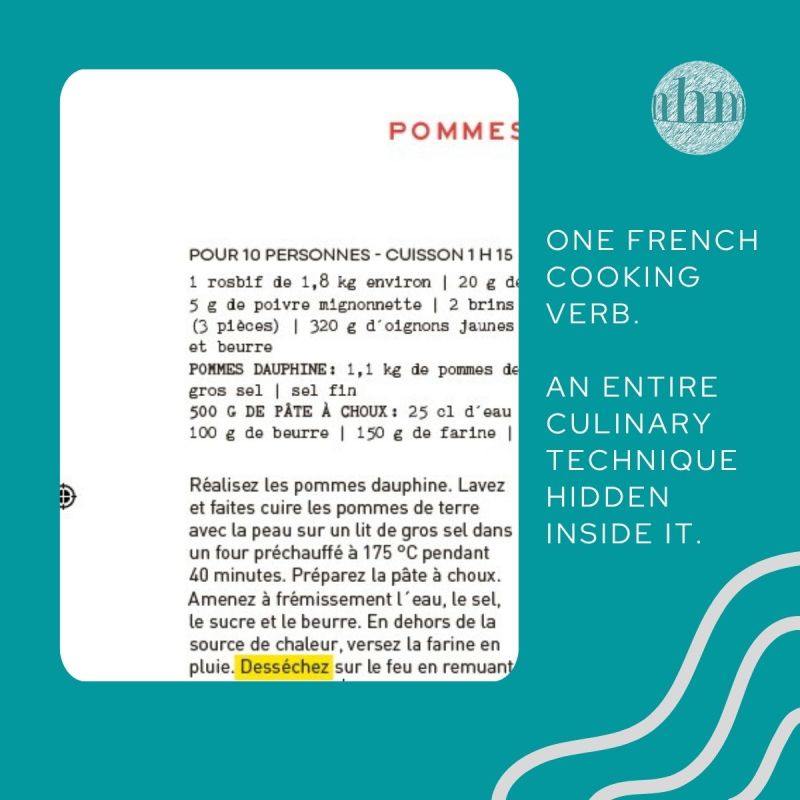
Or the verb “désecher” in choux pastry recipes. Literally, it means “to dry out,” but in practice it refers to beating the dough over heat until it forms a ball and pulls away from the sides of the pan.
One of my other favourites is “débouter”. In a recipe, a chef might simply write “débouter les courgettes”, but in English this needs unpacking into something like “trim the ends off the zucchinis.”
One word.
Several actions.
A whole technique hidden inside it.
Unpacking these layers of technical, cultural and culinary knowledge so that directions remain clear and usable for the reader is one of the challenges I love about translating recipes.
A French chef will use these verbs without questioning the assumed knowledge behind them. To them it is obviously what is involved, but to someone unfamiliar with French cuisine, the terms can remain a mystery!
I’m currently translating a book about making macarons – which are notoriously hard to perfect! One of the key terms and parts of the recipe is the “tant pour tant”. In macaron-making, “tant pour tant” is a technical pastry term referring to a mixture made from equal parts almond meal and icing sugar.
So much to learn!





 English