Translating a recipe isn’t just about translating the words. It’s about knowing what’s actually in the packet.
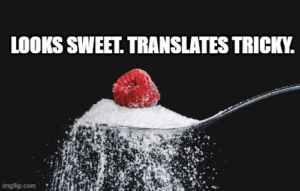
Let’s start with sugar. Sugar is sugar, right?
Not if you’re a pastry chef – or a culinary translator.
Because translating a recipe isn’t just about translating the words. It’s about knowing what’s actually in the packet.
Take sucre en poudre. It sounds as though it should mean “powdered sugar”. But in France, sucre en poudre is white sugar (often relatively fine, closer to caster sugar) while the very fine sugar used for dusting, icing and making macarons is sucre glace
And then there’s the English-speaking world.
If you’re making macarons in Australia or the UK, you’ll be reaching for icing sugar. In the US, the same ingredient is usually called powdered sugar or confectioners’ sugar.
That distinction matters.
Choose the wrong sugar and you’re not just changing a word on the page – you may be changing the texture, structure or finish of the recipe.
Culinary translation requires more than language, you need to understand what the ingredient does, what the cook needs to buy and what it’s called in their market.
I am constantly asking myself, “What does this French term mean?” and “What product should the English reader actually use?”
And don’t get me started on caster, raw, unrefined, brown or muscovado sugar…Sweet ingredient. Surprisingly tricky translation.
And now to questions.
Good translators ask questions.❓ Here’s why.
Not because every source text has problems (although sometimes they do! 🙃).
But because sometimes the most important part of translating is noticing when a recipe or text doesn’t quite add up.
Here’s a recent example from a pastry book I was translating.
The equipment list specified both a 22 cm tart ring and a 24 cm ring. But the 22 cm ring was never mentioned again in the method.
The dessert itself was being assembled in a 24 cm ring. So why was the 22 cm ring there?
My best guess was that it was intended as a template for piping the meringue discs. Based on the recipe and the image, that’s what made the most sense. The meringue sits inside the finished dessert, so a slightly smaller diameter would be logical.
But the fact that it made sense isn’t the same as knowing.
So I queried it.
This is one of the less visible parts of a translator’s job.
It’s not simply: French → English
It’s also: Read. Question. Research. Cross-check. Clarify.
A good translator needs to understand the content well enough to notice when a detail is missing. And while we are often afforded a certain amount of creativity in translation, we should also resist the temptation to quietly “fix” it based on an assumption. The text should be fact checked with the author or publisher.
Sometimes asking the right question is just as important as finding the right word.
And if I were an editor, a translator who never asked me any questions would worry me.
Sometimes the translation is clearer and more accurate than the original thanks to translation.




 English
